

Viettel High Tech Becomes the First Partner to Join Qualcomm's 6G Platform Early Access Program
Building on the success of 5G Open RAN, Viettel High Tech Industry Corporation (Viettel High Tech) has become the first partner selected by Qualcomm Technologies to participate in its 6G Platform Early Access Program.
On July 16, as part of a working session between Viettel Group and Qualcomm Technologies—chaired and witnessed by Lieutenant General Tao Duc Thang, Chairman and CEO of Viettel Group—Viettel High Tech and Qualcomm Technologies officially signed the 6G Platform Early Access Program.
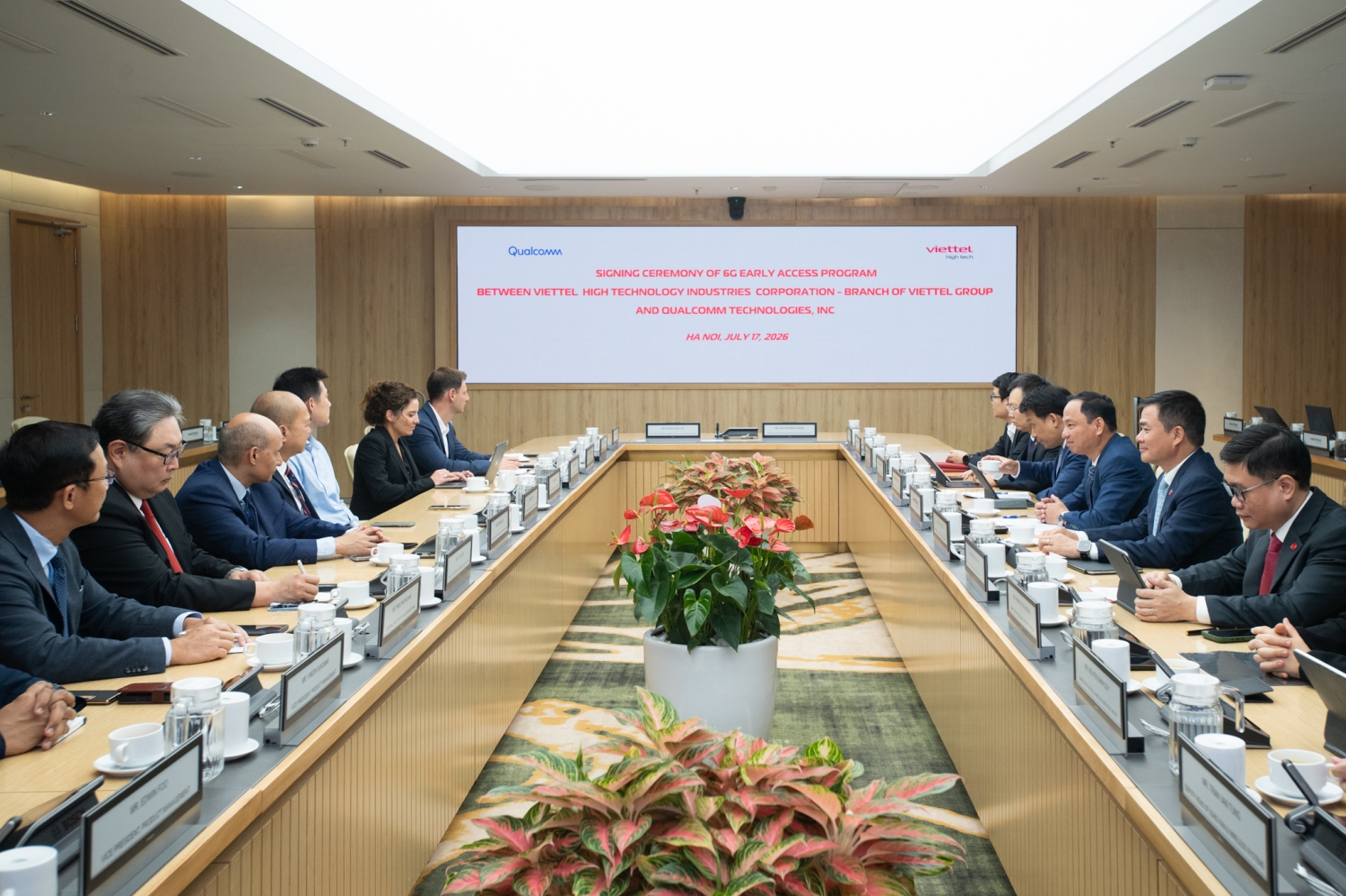
Accordingly, Senior Colonel Nguyen Minh Quang, CEO of Viettel High Tech, signed the cooperation agreement with Mr. Durga Malladi, Senior Vice President and General Manager of Technology Planning, Edge Solutions, and Data Center Business at Qualcomm Technologies.
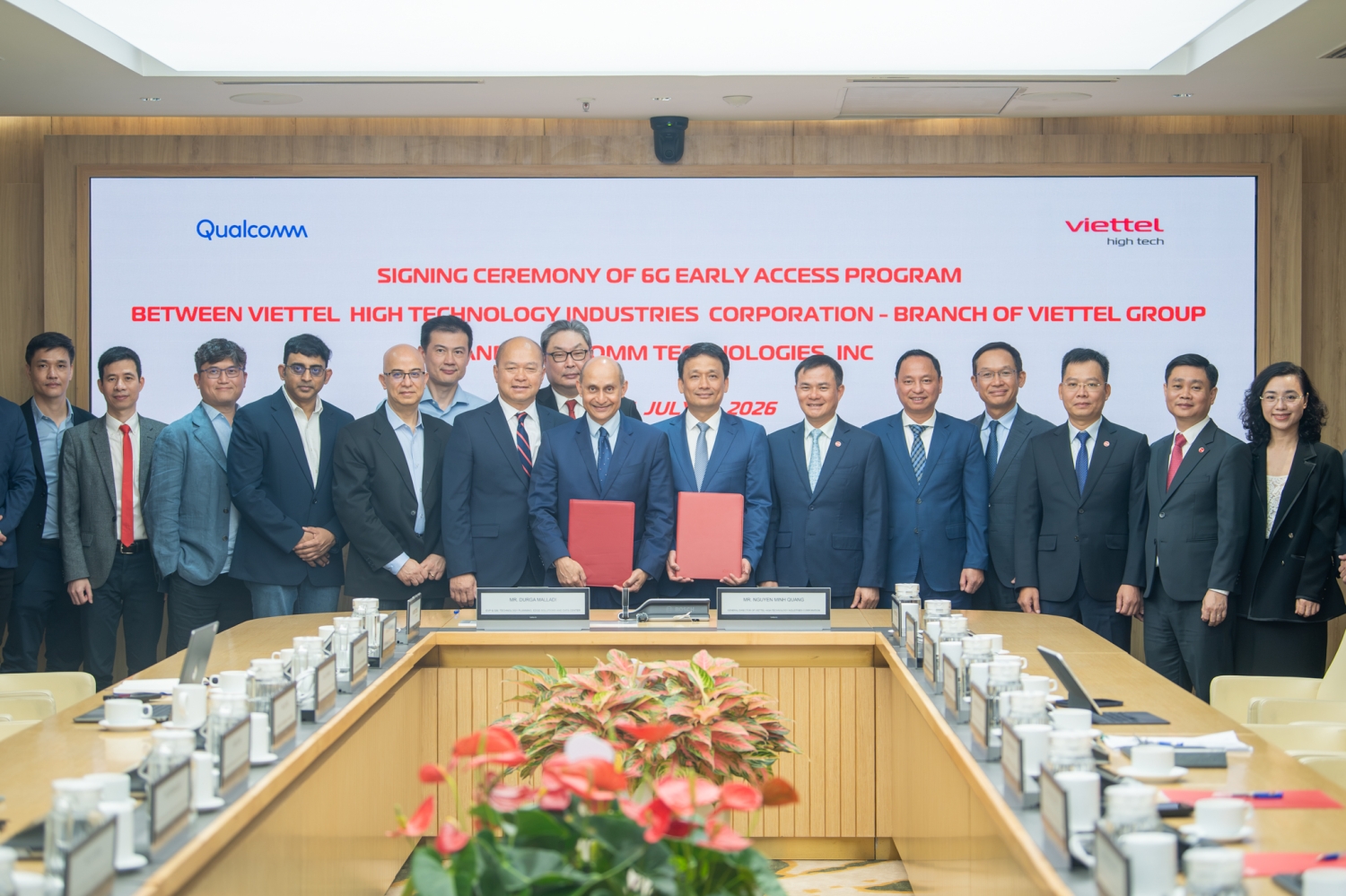
Under the agreement, the two parties will collaborate on researching, evaluating, interoperability testing, and integrating 6G technology platforms into telecommunications infrastructure products and devices developed by Viettel High Tech. Qualcomm will grant Viettel High Tech early access to its 6G platform, along with technical support, software tools training, and testing methodologies. On this foundation, Viettel High Tech will proactively research, integrate, and test products leveraging the 6G platform, aiming for deployment in Vietnam and international markets.
With this partnership, Viettel High Tech becomes Qualcomm's first global partner in the 6G Platform Early Access Program, marking a significant milestone in expanding their strategic collaboration from 5G Open RAN to next-generation mobile network technologies.
In an interview with Viettel High Tech, Mr. Durga Malladi expressed that Qualcomm was particularly impressed by Viettel High Tech’s achievements in 5G, notably its in-house R&D capabilities, commercialization of radio solutions, and rapid large-scale network deployment.
According to him, these accomplishments position Viettel favorably to participate in 6G development right from its early stages. Qualcomm is committed to accompanying and supporting Viettel throughout the R&D, testing, and deployment of next-generation mobile networks, aiming to help Viettel become one of the pioneers in 6G deployment in Asia.
Mr. Durga Malladi also highlighted that Viettel’s swift commercial deployment of 5G Open RAN serves as a reference model for global operators. Qualcomm is currently connecting several international telecom enterprises—including Rakuten (Japan) and major Indian operators—to study Viettel’s experience in R&D, manufacturing, and network rollout. This presents a key opportunity for "Make in Vietnam" telecommunications products to penetrate deeper into the global market.
Speaking at the session, Lieutenant General Tao Duc Thang, Chairman and CEO of Viettel Group, emphasized Viettel’s firm commitment to technology mastery, asserting that Viettel’s first pre-commercial 6G call must be conducted on systems and equipment fully researched, developed, and manufactured by Viettel. This underscores Viettel's consistent strategy to master the entire value chain—from R&D, design, and software development to manufacturing and live-network deployment.
In addition to joint research, Viettel requested Qualcomm’s continued support in expanding the international market for Viettel-developed 5G equipment across Southeast Asia, South Asia, Africa, and Latin America. Qualcomm affirmed its commitment to connecting Viettel with global operators and partners, facilitating international access to Viettel’s R&D and manufacturing capabilities.
Both parties agreed to deepen R&D collaboration in Vietnam. According to Qualcomm's representative, jointly establishing core technology pillars in the early stage of 6G holds strategic importance for shaping the 6G ecosystem and opens up broader opportunities compared to the 5G era.
Entering the 6G era, the scope of cooperation between Viettel and Qualcomm will extend beyond traditional radio systems. According to Mr. Durga Malladi, 6G is being designed as an AI-native network, where artificial intelligence is embedded directly into the core architecture. Consequently, both sides will expand their collaboration into high-performance computing, data center servers, sensor technologies, autonomous AI devices, and next-generation radio systems.
Qualcomm’s expanded partnership with Viettel High Tech is the result of years of close collaboration in developing next-generation mobile technologies. It reflects the strong R&D and commercialization capabilities that Viettel has built over multiple technology generations.
In 2015, when initiating 4G research, Viettel had virtually no baseline to inherit. Despite being a latecomer in telecom equipment manufacturing, Viettel chose the challenging path of self-research, self-design, and gradual technology mastery. Entering the 5G era with an open architecture strategy via Open RAN, Viettel step-by-step mastered the entire value chain—from design and software development to manufacturing and network integration.
To date, Viettel has deployed 24,000 5G base stations nationwide and plans to add 20,000 more in 2026, with over 15% of the equipment researched and manufactured in-house by Viettel High Tech. These milestones not only demonstrate the technological expertise of Viettel’s engineers but also help position Vietnam as one of the few countries capable of comprehensively researching, manufacturing, and deploying next-generation telecom infrastructure.
Most interacted
Viettel High Tech Becomes the First Partner to Join Qualcomm's 6G Platform Early Access Program
 0
0- 0
 1094
1094